Access the practice guide here
Introduction: HIV Care Within a Larger Life Context
Overseas-born gay, bisexual, queer, and other men who have sex with men (GBQMSM) are central to Australia’s contemporary HIV landscape, yet their pathways through diagnosis and care differ significantly from their Australian-born peers. Many navigate HIV while balancing additional priorities, including temporary visas, financial stability, employment, and housing security. They face unique intersectional experiences across language, cultural stigma, and unfamiliar health systems. For many overseas-born clients, HIV is not the main source of stress – the greater concern is visa insecurity and meeting requirements to maintain residency. Failing to recognise the wider context creates inequitable and marginalising experiences that undermine engagement and negatively impact long-term outcomes, which in turn prevent Australia from achieving virtual elimination of HIV by 2030.
Providing Inclusive HIV Care for Overseas-Born GBM: A Practice Guide (‘Practice Guide’) and the accompanying Summary Flowchart (‘Flowchart’) were created to respond to these realities, and to support clinicians who are not used to working with people living with HIV. While HIV sector clinicians often already understand these needs and respond well to clients, the Practice Guide and Flowchart are designed primarily for non-sector clinicians, emphasising an ongoing reality long recognised by community workers and peers: HIV care must extend beyond biomedical excellence with holistic and culturally responsive approaches to care.
About the Practice Guide and Flowchart
The Practice Guide and Flowchart were developed in partnership between ACON, the Kirby Institute, Positive Life NSW and were funded by a ViiV Healthcare Australia Positive Action Community Grant.
A series of community consultations were conducted with overseas-born GBQMSM living with HIV, healthcare professionals experienced in providing HIV care to these communities, and community organisations, including Positive Asian Network Australia (PANA) and the Positive Lantinx Australia Network (PLAN).
12 recommendations for patient-centred approaches were produced accompanied by practical, easy to implement conversation prompts and decision-making flowcharts. You can access the Practice Guide and Summary here.
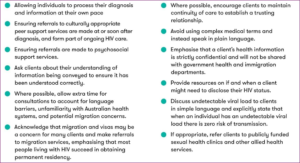 The 12 recommendations are accompanied by practical, easy to implement conversation prompts and a clinical decision-making flowchart
Diagnosis: A Moment of Shock Within an Already Overwhelming Life
Receiving an HIV diagnosis is rarely an isolated event. For overseas-born clients, it often collides with ongoing pressures related to migration and settlement. Many come from contexts where HIV remains highly stigmatised, associated with secrecy or poor access to care. One participant summarised the experience succinctly: “It was too much having that blast of information” (FG1, P2). Another highlighted the need for sensitivity: “[Newly diagnosed clients] need a more gentle, slower approach” (FG3, P5). Step A of the Flowchart mirrors this, inviting clinicians to assess emotional overwhelm and adjust pace accordingly. Medical details are best introduced gradually. As one consultant explained, “Think of this like learning to drive… soon, it will just be part of your routine” (Flowchart). Early reassurance is the foundation for trust.
“I agree with [providing information] bit by bit. It’s impossible unloading all that information at once”
(FG1, Pc, Living with HIV)
The Critical Role of Peer Support
Clinical expertise provides the medical backbone of HIV care, but for overseas-born GBQMSM, peer support often provides the emotional and cultural grounding required to meaningfully engage with treatment. Peers offer lived experience, credibility, and cultural nuance in ways that clinical services cannot replicate. Participants repeatedly described the profound value of peer connection: “Talking to someone who has been through this before can be really helpful” (Practice Guide). Another added that ACON’s workshops were “very helpful” after diagnosis (FG2, P5). Peer support helps clients understand Australia’s health system, contextualise HIV within their cultural reality, and rebuild confidence. Step C of the Flowchart emphasises early referral to peer support – not as an additional option but as core infrastructure for emotional stability, treatment adherence, and long-term resilience.
Visa Stress: The Silent Driver of Disengagement
Among the overseas-born clients accessing ACON’s programs, visa-related anxiety consistently emerges as the most significant source of distress – often eclipsing the diagnosis itself. HIV treatment is generally accepted quickly, and health improves rapidly. Yet anxiety about migration persists, often intensifying as clients feel physically better.
As one participant expressed, “Sometimes the visa is more pressing than HIV”
(FG3, P2)
This reality guided the development of the Practice Guide, but it also exposed deep discomfort across parts of the sector. When migration issues were introduced in clinician guidance, significant resistance emerged. Concerns were often framed as “We can’t give legal advice,” “We must remain neutral,” or “We shouldn’t imply anything about visa outcomes.” While expressed with good intentions, these objections revealed a broader cultural gap: many workers, particularly within predominantly white, Western organisational cultures, are trained to operate strictly “by the book.” Anything outside rigid neutrality feels unsafe.
However, the emotional impact of neutrality is not “neutral” for someone whose visa – and entire future – feels uncertain. When clinicians avoid the topic entirely, clients interpret this not as professionalism but as danger: a sign that their visa prospects are bleak or that something is being withheld. This gap between intention and impact exposes a lack of cultural understanding of the realities faced by overseas-born communities.
The Practice Guide therefore reframed migration communication. Clinicians cannot offer legal advice, but they can safely provide reassurance through general advice.
Clinicians can explain that HIV does not automatically block migration.
They can note that the vast majority of health waiver applications are successful, when prepared properly with timely legal support.
They can inform that organisations like HALC exist and specialise in this process.
These statements are statistically accurate, legally safe, and essential for trauma-informed care. Migration stress influences mental health, treatment adherence, follow-up attendance, and the ability to absorb information. Addressing it openly is not political; it is clinical.
Explaining U=U Clearly and Consistently
For many overseas-born GBQMSM, the concept of “undetectable equals untransmittable” (U=U) is entirely new. Awareness varies dramatically depending on the country of origin, education systems, and prior access to HIV information. One participant reflected, “I didn’t know what undetectable means really” (FG1, P5). Yet too often, clinicians rely on technical language that assumes prior knowledge.
The Practice Guide encourages the use of clear, plain explanations such as: “Undetectable means zero risk. You can’t pass it on.”
Repetition and gentle reinforcement are often necessary. For clients who have internalised decades of stigma, a clear explanation of U=U can shift their entire self-perception.
Mental Health: Anticipating Needs Without Waiting for Crisis
Mental health challenges following diagnosis are common, but many overseas-born clients do not spontaneously request support. Cultural stigma around counselling, unfamiliarity with therapeutic systems, or unclear expectations of what services offer can prevent people from seeking help. Step D of the Flowchart encourages clinicians to proactively offer mental health support and normalise it as part of holistic care. A simple prompt such as “Speaking to a mental health professional could help you adjust” can make support accessible and acceptable. Early intervention not only reduces distress but also strengthens engagement in clinical care.
Time, Trust, and Continuity in Care
Overseas-born clients often require longer consultation times because they are navigating multiple layers simultaneously: migration concerns, linguistic differences, cultural stigma, trauma histories, and systemic unfamiliarity. Continuity of care with the same clinician reduces repetition of traumatic narratives and builds trust over time. As one participant explained, “It helps to see the same doctor – it builds trust and saves you repeating things” (FG3, P5). A stable therapeutic relationship increases understanding, comfort, and adherence.
Navigating the Australian Health System
Australia’s healthcare system is complex even for locals; for newly arrived migrants, it can seem to be incomprehensible or impenetrable. Many clients are unfamiliar with Medicare rules, free sexual health clinics, s100 prescribers, peer services, legal supports, or the existence of community organisations. Additionally, access to healthcare services varies significantly between jurisdictions. As one participant noted, “You come to Australia, and those names mean nothing” (FG1, P6). The Flowchart encourages clinicians to actively demonstrate where to find services, rather than relying on verbal explanations alone. Showing a map, a website, or an online booking system empowers clients and reduces confusion.
Confidentiality: Addressing Deep-Rooted Fears
Many overseas-born clients come from countries where HIV information may be shared with employers, family members, or government authorities. This leads to persistent concerns about confidentiality in Australia. One clinician described a patient who “was convinced the government would read my notes” (FG4, P1). Proactively explaining how medical confidentiality operates in Australia – particularly around the protection of records from immigration authorities can significantly reduce anxiety and encourage ongoing engagement. Confidentiality should be reinforced repeatedly, especially during the early stages of care.
Person-Centred Care as HIV Prevention
The Practice Guide demonstrates that person-centred care—acknowledging migration stress, cultural context, stigma, and mental health—is not an optional add-on. It is a core component of HIV prevention.
When clients feel understood, respected, and supported, they are more likely to adhere to treatment, maintain care, and achieve viral suppression. Addressing the whole person strengthens both individual wellbeing and public health outcomes. The virus may be biomedical, but the experience of living with HIV is deeply social and shaped by broader systems.
Conclusion: A Sector That Welcomes, Not Worries
Overseas-born GBQMSM bring profound resilience, cultural diversity, and strength to Australia’s HIV response. Yet their needs are shaped by migration systems, racism, cultural histories, and the realities of diaspora life. To support them effectively, the sector must move beyond rigid neutrality and towards culturally safe, migration-aware practice. This requires humility, partnership, shared learning, and the willingness to discuss the issues that matter most to the communities we serve.
A participant captured this perfectly: “It helps to see the same doctor – it builds trust and saves you repeating things” (FG3, P5). Trust is the cornerstone of inclusive care. When we meet people
where they are – emotionally, culturally, and structurally – we build a sector that does more than treat HIV. We build one that supports belonging, stability, and thriving.
Australia’s HIV response is at its strongest when it listens to the communities it seeks to serve. Overseas-born GBQMSM have been clear: acknowledge our realities, understand our migration journeys, and walk with us – not just through the clinic, but through the complexities of culture, identity, and home. That is what truly inclusive care looks like.